
Introduction
Blocked heart arteries are a common and serious health problem worldwide. The condition,
known as coronary artery disease (CAD), develops when the arteries supplying blood to the
heart become narrowed or blocked by cholesterol-rich plaque, a process called atherosclerosis.
As blood flow to the heart decreases, patients may experience chest pain (angina), shortness of
breath, or, in severe cases, a heart attack.
When blocked heart arteries are diagnosed, doctors must choose between medical therapy,
angioplasty with stent placement, or bypass surgery. Understanding when a stent or angioplasty
becomes necessary helps patients make informed and confident decisions.
What Are Angioplasty and Stents?
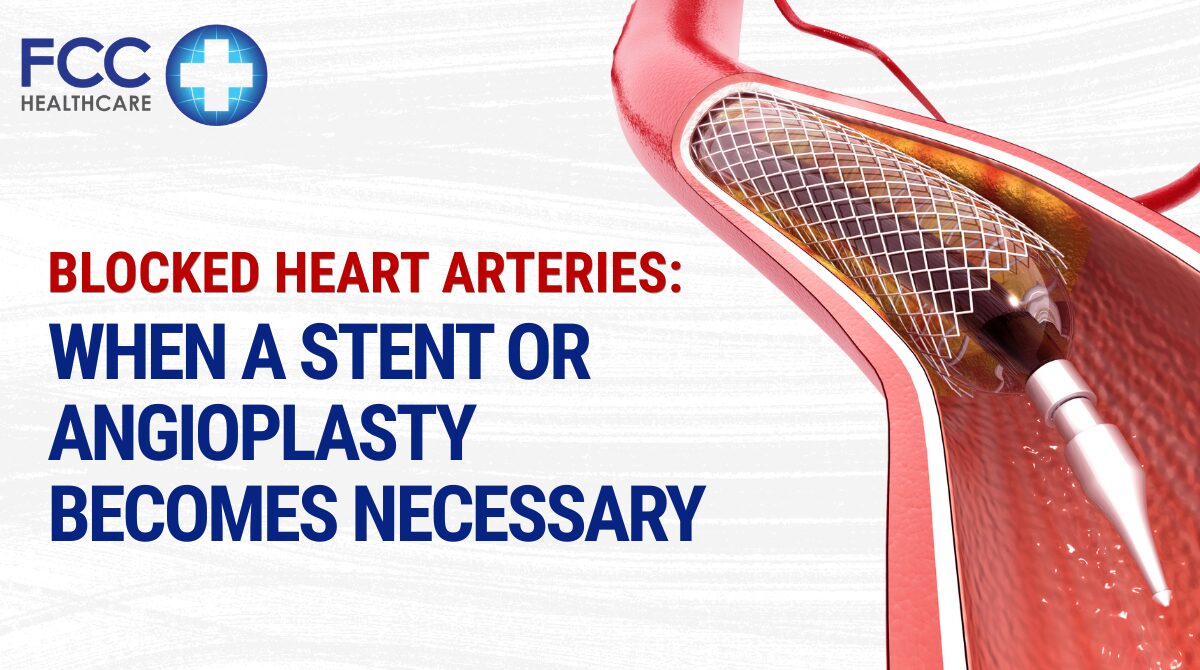
Angioplasty is a minimally invasive procedure used to open narrowed heart arteries. A thin tube
(catheter) with a small balloon is guided to the blockage and inflated to restore blood flow.
In most cases, a heart stent is placed during angioplasty. The stent acts as a permanent support
to keep the artery open. Modern drug-eluting stents slowly release medication that reduces the
chance of the artery narrowing again. Together, these steps are called percutaneous coronary
intervention (PCI).
When Is a Stent or Angioplasty Necessary?
The need for angioplasty depends on whether the condition is acute (emergency) or stable.
- Emergency Situations (Acute Coronary Syndromes
In heart attack situations, a stent is often life-saving.ST-Elevation Myocardial Infarction (STEMI):
This occurs when a heart artery is completely blocked. Emergency angioplasty with stent
placement is the preferred treatment, as it rapidly restores blood flow and reduces death and
heart damage.
NSTEMI and Unstable Angina:
These involve partial blockages. Patients with ongoing chest pain, heart failure, or abnormal
heart rhythms usually require early angioplasty and stenting to prevent deterioration.
2. Stable Coronary Artery Disease
In stable CAD, symptoms occur during exertion and improve with rest. Here, stenting is not
always urgent.
• Symptom Relief:
If chest pain persists despite medications, angioplasty becomes necessary to improve quality of
life.
• Large Areas of Poor Blood Flow:
If stress tests or scans show a significant portion of the heart is not receiving enough blood,
doctors may recommend stenting even when symptoms are mild.
What Research Evidence Shows
Large studies published in the New England Journal of Medicine have shown that in stable
coronary artery disease, angioplasty does not significantly reduce death or heart attack risk
compared to medication alone.
However, trials such as ISCHEMIA and ORBITA-2 confirmed that angioplasty significantly reduces
chest pain and improves daily functioning, especially in patients with persistent symptoms.
This means stents are most valuable for symptom relief and emergency treatment, not as a cure
for heart disease.
Risks and Long-Term Care
Angioplasty is generally safe but carries risks such as bleeding, artery injury, or rare stent
clotting. After stent placement, patients must take blood-thinning medications to prevent clots.
A stent treats a specific blockage but does not stop heart disease from progressing. Long-term
success depends on lifestyle changes such as healthy eating, exercise, quitting smoking, and
managing blood pressure, cholesterol, and diabetes.
Conclusion
A stent or angioplasty becomes necessary in two main situations:
1. During a heart attack, to quickly restore blood flow and save heart muscle
2. In stable coronary artery disease, when medications fail to control symptoms or blood
flow is significantly reduced
While medications remain the foundation of heart disease management, angioplasty plays a
vital role in emergency care and improving quality of life for selected patients.